Как подключить систему накопления к сети? Режимы, тарифы и требования к оборудованию
Grid connection is not just about connecting the battery to the grid: if the mode is selected incorrectly, the inverter protocol is incompatible, and the certifications are incomplete, the project may not be accepted. This article clearly explains the three mainstream grid-connected modes and the rigid requirements for equipment.
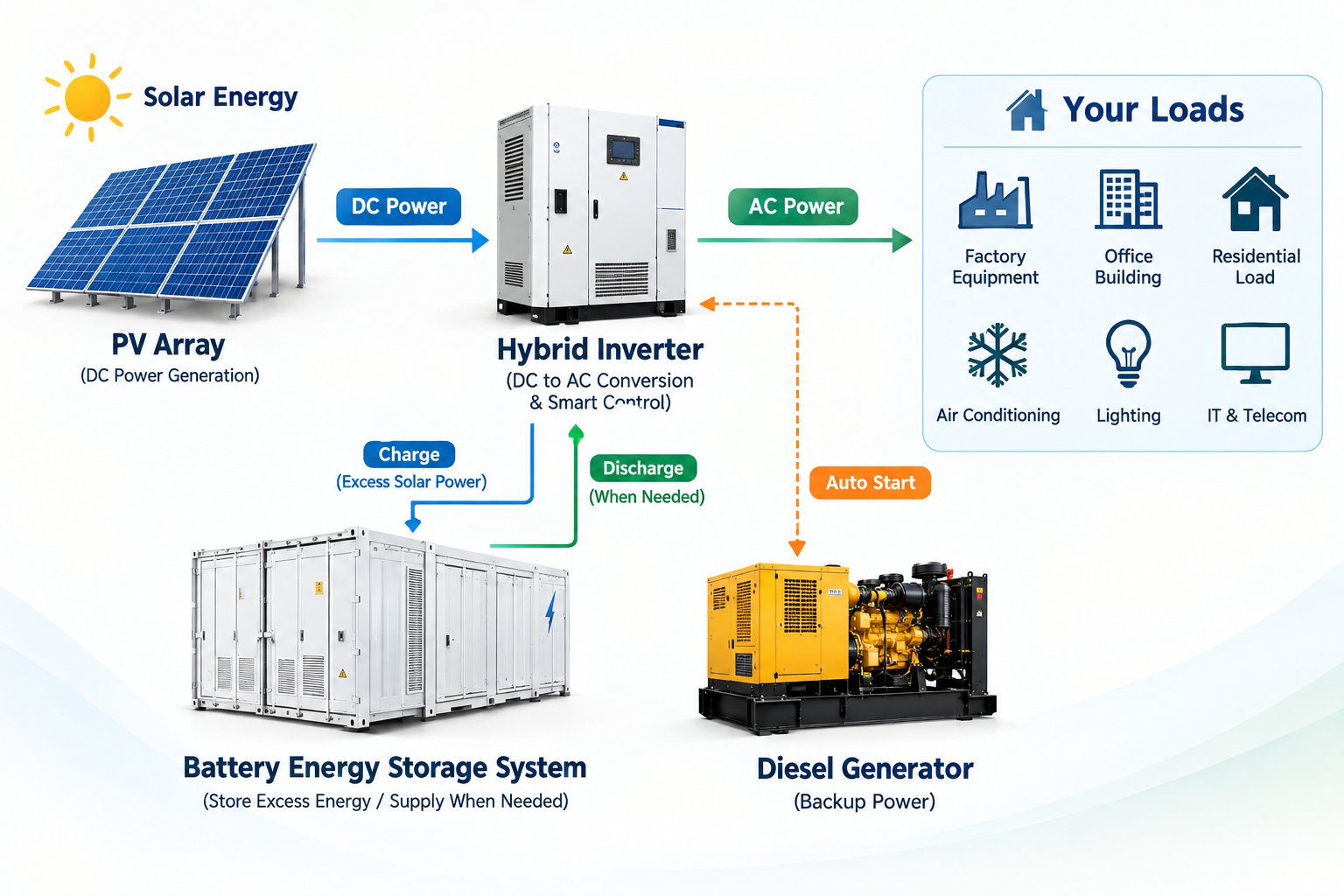
"Grid connection" is the concept that customers ask the most about and is the most confusing in energy storage projects. The relationship between a battery energy storage system (BESS) and the power grid determines how it makes money. This article explains the three mainstream grid connection modes at once.
Mode 1: Spontaneous self-use, spare power not connected to the Internet (the most common)
Photovoltaic + energy storage closed-loop operation, the battery gives priority to storing excess photovoltaic during the day for night use.No reverse transmission of power to the grid. It is suitable for markets where the on-grid electricity price is low or where reverse power transmission is not allowed (some Southeast Asian and African markets). Minimum equipment requirements: battery + hybrid inverter is all.
Mode 2: Peak and valley arbitrage (the main gameplay of industry and commerce)
In power grids with obvious peak-to-valley price differences (the peak-to-valley price difference in China's industrial and commercial industries is generally more than 0.7 yuan/kWh, and even higher in many European countries), energy storageValley charging, peak discharging, earn the price difference. Industrial and commercial energy storage cabinets in the 200–500 kWh class are the main models. Key parameters:
- Cycle life: complete charge and discharge once a day, 365 times a year,8,000 cycles ≈ 8+ years calendar life;
- EMS dispatch: An energy management system that supports electricity price period programming and demand control is required;
- Battery consistency: When multiple cabinets are connected in parallel, the battery batch consistency and BMS balancing capability determine the system attenuation speed.
Mode 3: Grid-connected power backup/frequency regulation (large-scale projects)
MWh-level energy storage participates in grid frequency regulation, capacity markets, or as UPS-level power backup for critical loads. This type of project isBattery cluster management (BMS cascade), fire certification, grid access testingThe most demanding, often requiring certifications such as UL 9540 / IEC 62619.
Three rigid requirements for grid-connected equipment
- Matching of inverter and grid parameters: Voltage level, frequency, and islanding protection must comply with the local power grid code (such as Germany VDE-4105, UK G98/G99, Australia AS4777);
- Battery and inverter communication: CAN/RS485 protocol docking, the charge and discharge curve of lithium battery is issued by BMS in real time;
- Certification documents: Export equipment is provided with UN38.3, MSDS, and CE; the target market has other certifications (UL 1973 / IEC 62619) that need to be confirmed in advance.
HYSPERIX’s grid-connected energy storage product line
Household side: L series cabinet (5–11.2 kWh), SE series (15.36–35 kWh, BYD battery), Pro series (16–32 kWh, CATL/CALB battery, 5-year warranty), all provided RS485/CAN communication interface, suitable for mainstream hybrid inverter brands. Industrial, commercial and large-scale projects support customized integration from 100 kWh – 8 MWh, OEM/ODM starting from 500 units.